At BlueDot, we have the DNA of an academic institution and ultimately use the business to implement and disseminate scientific knowledge using technology.The timing was important for a company like yours to come along. How does BlueDot work, exactly? Our digital early warning system is broken down into key components that we refer to as the four D’s: early detection of threats; anticipating how threats will disperse around the planet because they move very quickly; anticipating disruption; and dissemination in terms of how we get insights into the hands of the audience who really needs it. Ultimately, our belief is that this is really about empowering the whole of society. This is not information that can be sitting in the hands of a small group of public health officials. We need to be empowering organizations more broadly in society. I’ll go back to the first “D”—detection. One of the things that we learned about outbreaks during SARS was that if we rely on official reports from public health and government agencies around the world, information may not always come in the most timely manner and we may be waiting longer than we would like. We’ve been using the internet as a medium to gather information, early rumours, and news of potential outbreaks from unofficial sources. This includes the world’s online media and a wide variety of health blogs and forums, as well as information that is coming officially from government health organizations. Now the internet is, of course, a vast medium. There are all these different languages and it’s all unstructured text data. This is where we’ve been using what is called natural language processing and machine learning, which broadly fall under the umbrella of artificial intelligence (AI). We use these types of analytical tools to process and make sense of vast amounts of data currently in 65 languages, and we’re tracking news of outbreaks involving over 150 different diseases and syndromes. Experts in infectious diseases have worked with our data scientists to train this engine to build algorithms that can ultimately replicate human judgment about what we need to be paying attention to and what we don’t. Ultimately, this engine is operating every 15 minutes around the clock, 24 hours a day, 365 days a year. It’s a metaphorical smoke detector that is looking for early cues that there may be a threat emerging.
We’re a deliberately eclectic mix of physicians, veterinarians, ecologists, data scientists, geographers, epidemiologists, computer scientists, and engineers.Aside from industry pace, what do you think are the hurdles that prevent us from embracing big data fully? Part of the issue is there’s a technical challenge. The problems that we’re dealing with in health, and in particular infectious diseases, are not ones that you can tackle with one set of expertise. You could put a thousand data scientists on this problem and not get very far. You could put a thousand physicians on this problem and not get very far. One of the things that we’ve built at BlueDot is a diverse set of skills. We’re a deliberately eclectic mix of physicians, veterinarians, ecologists, data scientists, geographers, epidemiologists, computer scientists, and engineers. Every one of us brings a slightly different perspective to this problem, which is needed in order to derive meaning. One of the reasons why I started BlueDot was because I wasn’t necessarily seeing a diversity of skill sets and perspectives in the other environments that I was interacting with. In the academic sector, we are largely birds of the same feather who tend to hang out together. When it comes to making use of big data, there is a vast amount of untapped, latent potential that we haven't really made full use of. Culturally, data is one of these interesting things where people tend to hold it close to themselves and not share it. We have to think of data as a vital asset and develop a strategy where we can harness the full potential of it. Not just domestically, but integrating it with diverse sets of data to understand what’s happening around the planet. Canada does not have a closed population. We’re a microcosm of the world and if there is an outbreak or a threat that appears anywhere in the world, there’s a pretty good chance it’s going to find its way into our country. When it comes to the data that you’re harnessing, where does the balance between human intelligence and big data come into play? We’ve always been of the mindset that we need to all be playing to our strengths. Machines can process vast amounts of data and replicate certain types of processes. They don’t need to sleep and can operate 24 hours a day. Humans bring a higher order of understanding. If I think about our early detection of COVID-19, it was our understanding of history that turned out to be very relevant there. If you think about machine learning and AI, we don’t have 5,000 outbreaks of SARS to develop a set of algorithms to train a machine. We’ve got an understanding of human judgment and history, so how do we bring it all together? We’ve always seen the two as complementary. Let a machine do what it does well, and let humans do what we do best. These are not two conversations that are mutually exclusive. Yes, absolutely. They are complementary.
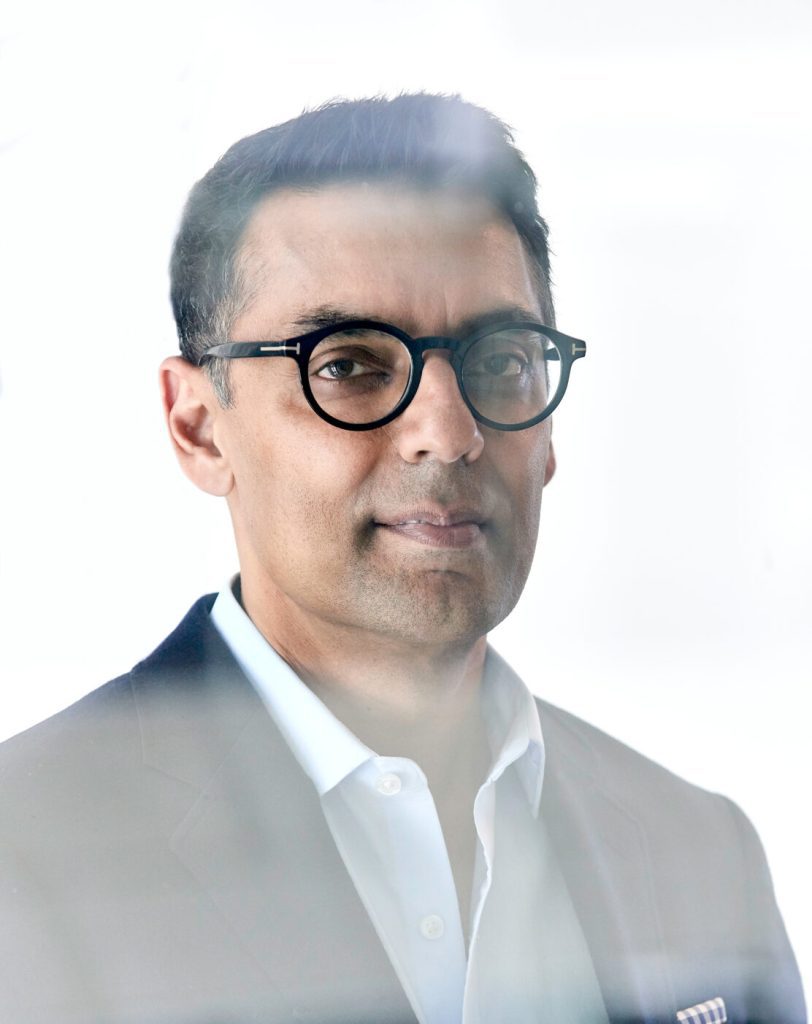
I founded BlueDot not because I was looking for an additional job beyond working as a physician and an academic, but because there was an unmet need and opportunity to connect people’s lives more broadly.As a professor that did it for years, writing grants is not a particularly timely process and can take a long time to generate capital. When your grant runs out, you’ve got to figure out what to do next and it’s a cumbersome process. What we’re doing now is generating jobs and insights that are protecting populations. We’re selling and licensing our technologies to countries around the world that are improving lives and allowing us to reinvest revenue because time is our most valuable resource. The clock is ticking right now, we just don’t know when the next [pandemic] will appear. From my perspective, this is a way to rapidly accelerate and drive innovation. Secondly, it’s important for us to recognize that in order to tackle these kinds of threats, we need to be empowering the whole of society. It’s not enough for an insight to sit in the hands of a group of people in the public health agency. These insights have to get to the frontlines of our healthcare workers and hospitals. Sick patients don’t go to the public health department, they go to the emergency department. While many of us might think that these insights are delivered there instantaneously, it’s not the case. We need to have more astute clinicians and empower our frontline healthcare workers with meaningful insights so they can protect themselves and the rest of us. Lastly, it’s important to recognize that industry can be a part of the solution. One of the things that we’ve learned with COVID-19 is that companies with global footprints are trying to think about ways to protect their employees and, in some cases, their customers, as in the case of an insurance company. We are incentivized to anticipate disruptions in business continuity or broken supply chains that could really impact the financial resilience of a business. So, there’s an unmet need where our approach has built out an early warning system to disseminate insights not only to the public sector, but to healthcare and private sector organizations. We all need to be taking action if we’re going to effectively mitigate this kind of risk.
profit and purpose do not have to be a zero sum game.What do you think is the biggest lesson that we’ve learned from COVID-19 when it comes to early detection and harnessing big data? What do we need to do in order to prevent something like this from happening again? In public health and medicine, we often talk about different levels of prevention—primary, secondary, and tertiary prevention. We need to think about this problem in the same tiers. Primary prevention is really about preventing something from happening in the first place—a vaccine would be an example here. When we think about COVID-19, what we are dealing with today is the symptom of a much broader condition. We are dealing with the fact that our world is changing. How we interact with the world around us is the catalyst to these types of outbreaks. About three-quarters of all new emerging diseases that we have seen have their origins in animal populations and have moved over into humans—SARS, HIV, Ebola, Zika, swine flu, H1N1. Mother nature is trying to tell us something, and that [has to do with] the way we are interacting with the world around us, whether through agricultural industrialization, disruption of wildlife ecosystems, climate change, or the mass consumption of wildlife. These factors are catalyzing the emergence and spread of many infectious diseases that are having devastating consequences to humanity. Today, we are very focused on COVID-19, and we should be because this is the crisis that we’re in right now. What I hope we don’t lose sight of is the fact that this is a moment for reflection as well. We have to ask ourselves how we got here in the first place? Why are we seeing more outbreaks than we’ve ever seen before? This is an awakening. The second piece is secondary prevention, which is early detection. This would be akin to getting a colonoscopy to make sure you don’t have colon cancer, or you’re detecting it before you even know it. What BlueDot is building is an early warning system to detect threats at the earliest stage possible. If there is one key lesson that we have learned, it’s that time is everything. It is our nonrenewable resource; we don’t get it back and we have to use it wisely. If we intervene early, we can change the code and we might be able to prevent an outbreak or change the course of one to mitigate its consequences. Time is critical. An early warning system is needed to have a bird’s eye view of what’s happening around the planet, understand risks of dispersion, and what kind of disruption might occur so that we can respond in a way that is commensurate with the risk. Tertiary prevention is about how we minimize harm once something is already underway. In the case of COVID-19 where the outbreak is underway, how can we quickly detect cases, identify contacts, and minimize consequences? Right now, we’re focusing on tertiary prevention to prepare for what may be coming in the weeks and months ahead. When we look at how we can prevent this from happening again, we have to look past tertiary prevention and firefighting to mitigate and manage risk. We have to think about secondary prevention and early warnings in order to use our time effectively and act appropriately. We have to also think further upstream about primary prevention—why are things happening in the first place and what actions do each of us have as global citizens? If this has taught us anything, it’s not just that every human’s health is connected around the world, but that we’re also connected to every other living system on our planet. That is an important piece for us to not lose sight of; it’s incredibly important for us to reflect on this. We may not have the capacity to spend a lot of time to think about it at this moment, but it will be very important for us to look back and ask ourselves how we avoid getting into the same position again. If we don’t, we may find ourselves back here sooner than we would like.