
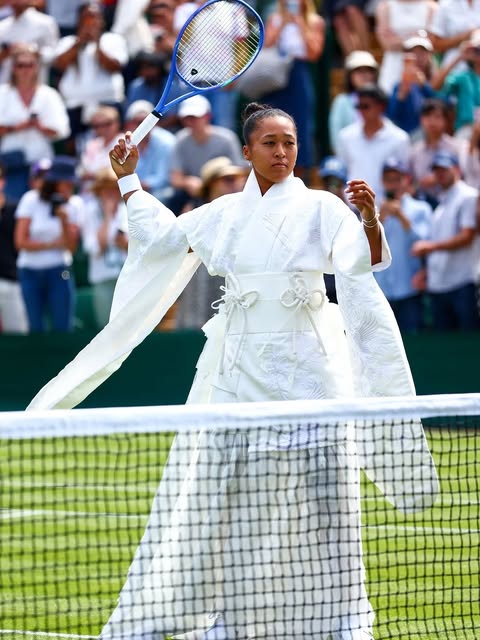
Naomi Osaka’s Wimbledon Opening Ceremony, Recut in Kimono Silk
At the Wimbledon opening ceremony, Naomi Osaka wearing a Kimono by Japanese designer @_hanayagi felt less like a red carpet moment and more like an argument, quietly made, for the power of clothing with a memory. Tennis has its own strict poetry, all crisp whites and inherited rituals, but Osaka arrived in textiles that carried the weight of another canon entirely. The result was disarmingly beautiful, and pointed in the way the best style always is.
The look was built from upcycled vintage kimonos, a traditional shiromuku wedding dress, and a deconstructed wedding dress. Three garments, three different ideas of ceremony, re composed into one silhouette that read as both reverent and modern. You could almost hear the fabric before you fully saw it, that soft rustle of silk that signals intention. It was the kind of craft that rewards proximity, seams that feel considered, not merely clever.
Naomi Osaka wearing a Kimono at Wimbledon, and why it landed
Wimbledon is famously conservative about what athletes wear on court, but the opening ceremony leaves room for personal language. Osaka used it. Naomi Osaka wearing a Kimono by @_hanayagi did not rely on shock or spectacle, it relied on specificity. Vintage kimono cloth has a particular depth, colour that seems to sit in layers, patterning that behaves like punctuation. Against the tournament’s manicured green, the textile looked almost cinematic.
More importantly, the garment brought bridal references without costume. The shiromuku, traditionally worn for Shinto weddings, carries an aura of purity and formality. Here, it was not treated as museum relic, but as living material. Deconstruction, in the right hands, can be a form of respect.
Upcycling, without the scolding
There is a version of sustainability that arrives with a lecture. This was not that. The upcycled vintage kimonos and reworked wedding textiles felt intimate, tactile, and luxurious, which is exactly the point. If you want people to choose repaired, repurposed, re cut clothing, it has to seduce first.
For readers tracking how fashion is moving right now, this sits neatly alongside the appetite for archive and vintage across our Fashion stories, and it echoes the way modern celebrity dressing is increasingly about authorship, not just labels. Consider, too, how often sport becomes a stage for cultural conversation, something we return to in News and Style.
A designer to watch, beyond the tournament
Japanese designers have long understood that invention can begin with restraint. @_hanayagi’s work, at least in this outing, trusted proportion and fabric to do the talking. The references were legible, yet the finish felt current, the kind of piece that belongs as much in a gallery as it does under summer sunlight in London.
If you want context for the larger kimono conversation, the Japan National Tourism Organization offers a thoughtful primer on tradition and regional dress. And for Wimbledon’s own history of pageantry, the tournament’s official home at wimbledon.com is a reminder that ceremony is the point, not the accessory.
Ultimately, Naomi Osaka wearing a Kimono at Wimbledon worked because it refused to flatten culture into a motif. It read as personal, made, and worn with intention. In a season crowded with outfits that shout for attention, this one simply held it.
Image Credits: 蘭 .