
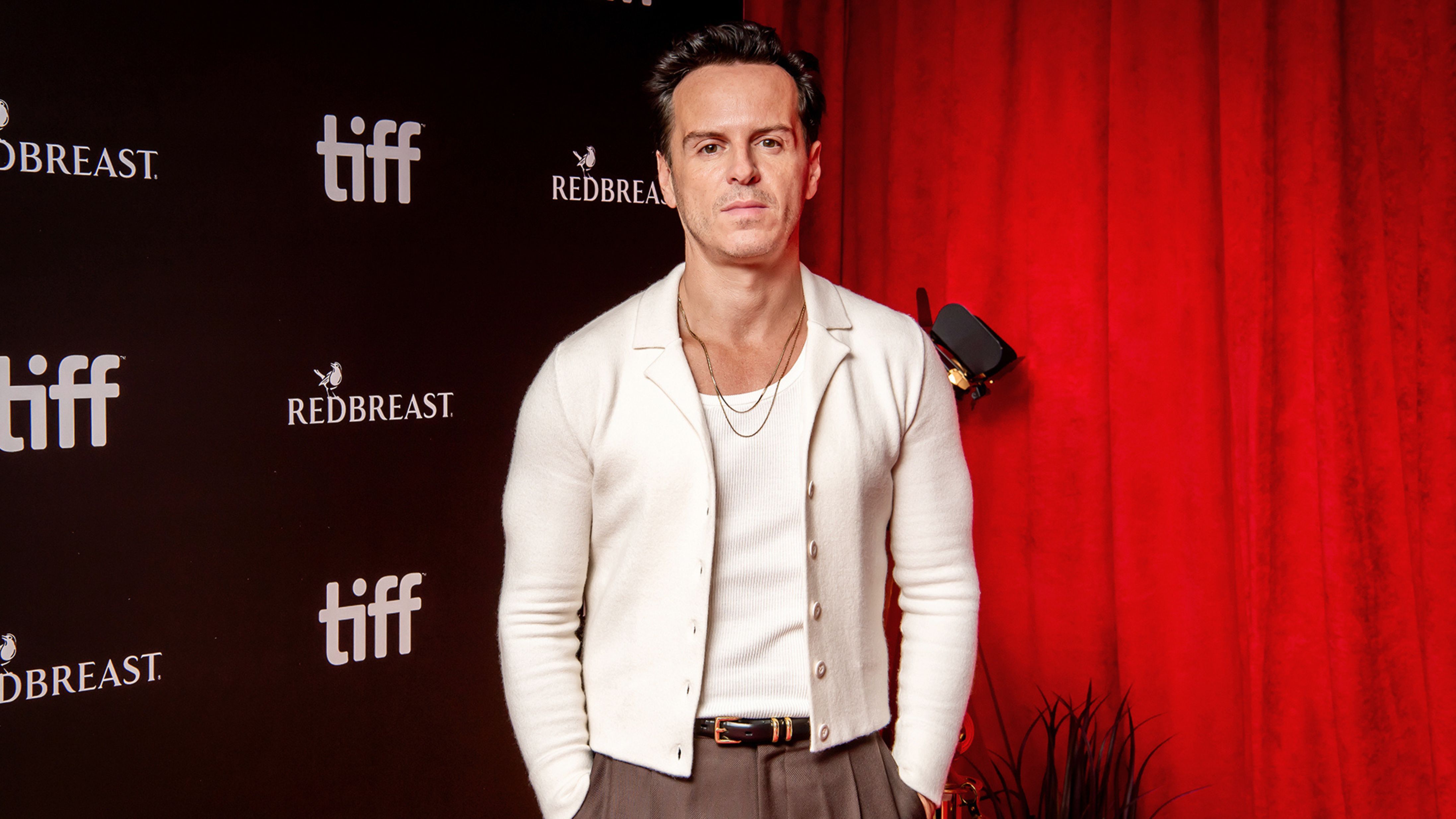

At the 2026 Toronto International Film Festival, few performances have generated as much anticipation as Andrew Scott’s in Elsinore. The acclaimed Irish actor steps into the role of Ian Charleson, the celebrated stage actor whose legendary 1989 performance as Hamlet unfolded while he was privately living with AIDS, creating a portrait of extraordinary artistry, vulnerability, and courage. The film has quickly emerged as one of TIFF’s standout titles, with Scott delivering what many are already calling one of the defining performances of his career.
This year, Scott arrives in Toronto wearing two hats. Alongside premiering Elsinore, he’s also serving as Global Brand Ambassador for Redbreast Irish Whiskey. The brand’s Unhidden platform is an initiative dedicated to championing emerging filmmakers, overlooked cinematic gems, and the creative voices waiting to be discovered. Returning to TIFF for its second year as the festival’s Official Whiskey, Redbreast Unhidden encourages audiences to look beyond the biggest premieres and embrace the thrill of finding exceptional stories hidden in plain sight.
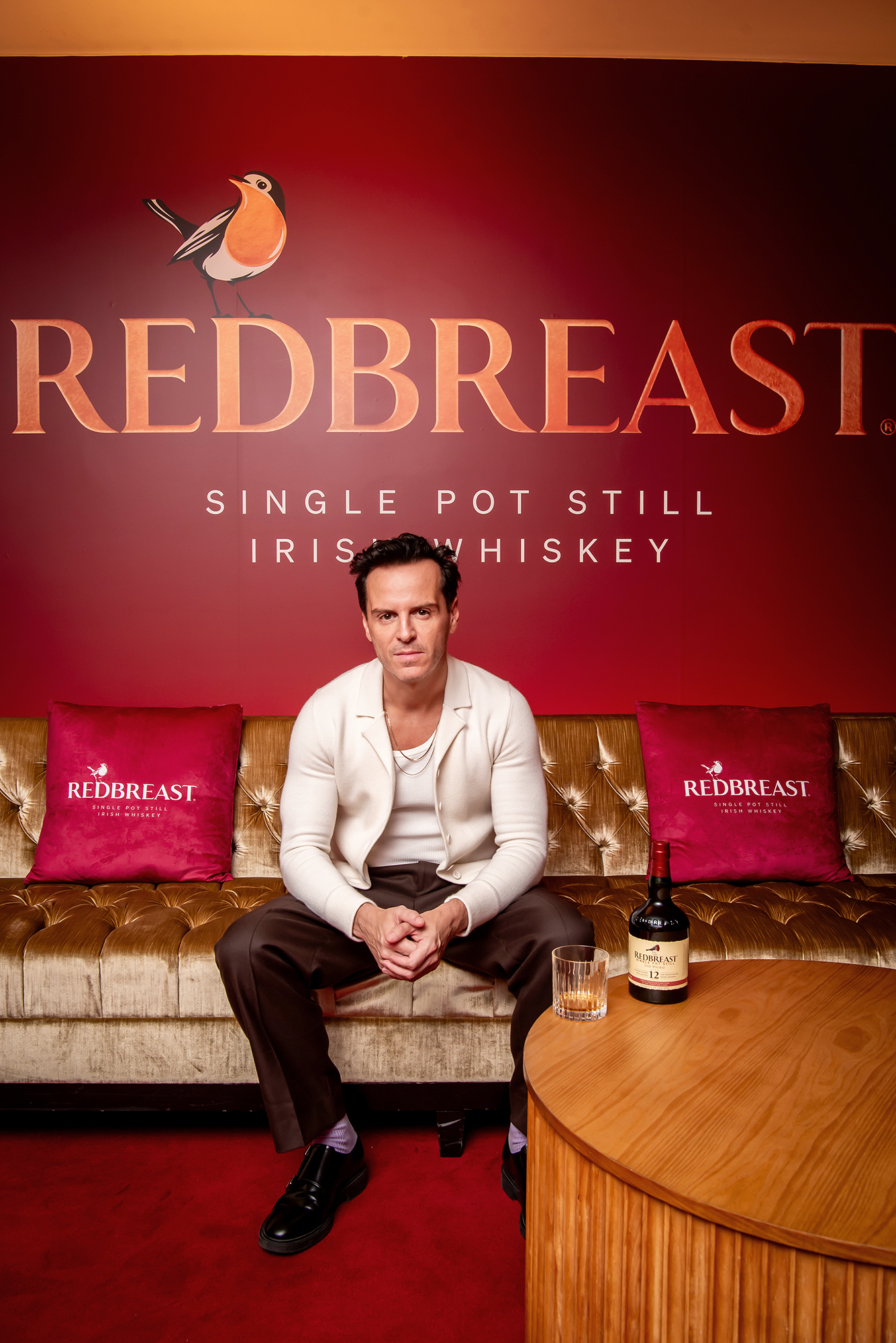
It’s a fitting partnership for an actor whose own career has been defined by fearless, unconventional choices. From his seductive complexity in Fleabag to the devastating intimacy of All of Us Strangers, the chilling precision of Ripley and now the emotional weight of Elsinore, Scott has consistently gravitated toward characters who reveal the hidden contradictions of being human rather than simple heroes or villains.
In conversation with GLORY, Scott reflects on choosing meaningful projects, collaborating with Olivia Colman, portraying queer history with responsibility, and why authenticity (not perfection) is ultimately what connects us most.
We’re here at TIFF with Redbreast in support of the Unhidden platform. Tell us more about what this initiative is setting out to accomplish?
Andrew Scott: It’s really about throwing light on new voices. It’s a great Irish brand, and as an Irish person, I’m proud to be representing it. I’ve been working with them for a while now, and what I’ve really appreciated is how authentic they are in encouraging artists. I believe in supporting artists, so it’s a partnership that feels very genuine.
You have an incredible body of work that spans love stories, psychological thrillers, Shakespeare, comedy, and television. Looking back, what’s really influenced your decision to say “yes” to the projects that you’ve taken on?
AS: It’s always the script. Literally, that’s everything.
You can’t make a great movie out of a mediocre script. Of course, the actors and the director matter, but chiefly, if you read the first couple of pages and feel that someone’s got a unique voice, that’s what I base everything on.
That can encompass Shakespeare, obviously (he’s a pretty good writer), but whenever you’re reading something for the first time, if there’s a flair in those opening pages, that’s incredibly rare.
Your role in Elsinore feels like one of a lifetime. At its heart, the film seems to ask what it means to live honestly and truthfully in a world full of performance—to unearth the hidden parts of ourselves, so to speak. Why do you think that idea will resonate so strongly with audiences today?
AS: I suppose that question resonates in any era. Today, I think we’re sometimes encouraged toward a more homogenized society. What we actually want from our artists is singularity; we want people to be truthful to who they are.
Often you think that the thing that makes you different is the thing that’s going to be your downfall. But actually, the most successful people are the ones who aren’t afraid of who they are.
It’s like reading a book: the hand of the author reaches through the pages and connects with the reader. You’re only really going to connect with other people by showing your whole self, flaws and all.
You’re working alongside a titan of industry, Olivia Colman. What did you learn about yourself or your craft from working with someone like her? Did that experience reveal anything you weren’t aware of before?
AS: Olivia is one of the best actors in the world. This is our third or fourth project together. Obviously we did Fleabag together, and she’s somebody who lives completely in her truth. We have a similar process in that we take the work seriously, but we don’t take ourselves too seriously.
She’s enormously playful, emotionally present, and intelligent. It was a great honour to work with her. I’m incredibly fond of her.
You’ve now worked with her across multiple projects. What felt different this time compared to the first?
AS: I guess it’s the subject matter. We did a radio play together, we did a film where it was mostly just voices, and of course Fleabag, where we didn’t actually have a huge amount to do together.
But here, the relationship between Dr. Margaret Johnson and Ian Charleson is enormously special. They begin from an antagonistic place and struggle to understand one another, but by the end of the film they reach a much deeper understanding.
It’s really about the tension between safety and freedom, quality of time versus quantity of time, and ultimately, what those questions mean for doctors and patients.
Much of this Redbreast campaign has similarities with the queer community in terms of realizing your full potential once you can live openly and freely.
You’ve played so many incredible queer characters throughout your career. As we’re seeing more queer stories being told, what kinds of stories would you like to see more of?
AS: I don’t really have a specific answer because it’s a bit like asking, “What kind of stories would you like to see in the straight community?”
I don’t think there has to be one particular type.
Queerness exists in as many forms and as many different storylines as straight life does. I love fluffy romance films, but I also think it’s very important to know our history and to understand the people who came before us and led us toward the growing freedom we enjoy today.
We have to celebrate both things.
Absolutely.
AS: It’s very important to look back at our gay forefathers and be grateful for that progress, for how much they changed people’s sense of safety around their sexuality.
For many people, having sex was potentially a death sentence. That’s an absolutely horrific reality that people had to endure and fight against. And it’s all very, very recent.
So I think it’s important that we remember that while also celebrating joy, fantasy, and lighter stories. Those two things can absolutely exist together, just as they do in the straight community.
To your point, it’s remarkable how recent that history really is. It can feel like something from a distant past, but in reality it was only a generation ago. Ian Charleson’s legacy extends far beyond Shakespeare. His decision to publicly acknowledge (after his death) that he had died of AIDS changed public understanding in Britain. What does it mean to inhabit a role connected to someone whose artistic legacy embodies so much courage? And what does courage mean to you today?
AS: In terms of courage, it’s a great question. I feel incredibly grateful to work in an industry that’s populated by queer people now. One thing I’d always say is that your sexuality isn’t a flaw, but nor is it a virtue. It’s a facet of who you are.
The important question is: what else do we cultivate as human beings?
It’s something we can absolutely be proud of, but I love being in situations where you realize there’s a gay architect, a gay lawyer, a gay whatever. It breaks down that reductive idea of what queer life is supposed to look like.
The courage is in saying, “I can be whatever I want.” Some people like to go out partying, some people like staying home doing a jigsaw. Sexuality isn’t your entire identity, and that was such an insidious idea for so long.
In some ways, the internet has opened people up to finding communities around anything: queer pottery groups, queer hiking groups, whatever floats your boat. I really like that. The courage is simply being fully yourself.
As someone who’s now helping spotlight emerging filmmakers through Redbreast, what kinds of voices do you think can add something new to the film landscape? What excites you most about the emerging talent coming through today?
AS: It’s interesting looking across all these films.
I think what you have to have is some sort of flair. That could be linguistic, it could be in the script, it could be the way you use the camera, it could be a political voice, a sense of humour, or a documentary-style approach to filmmaking.
The work that really excites us is the work with genuine individuality.
It doesn’t have to be individual in every possible way, but it needs something where you think, “That was unlike convention.” Whether it’s visually thrilling, structurally surprising, or emotionally distinctive, it feels like someone’s signature.
There’s no limit to creativity. Of course, there’s always a commercial imperative, but the most important thing is to say: This is my autograph. And then give it as much flavour as possible.
This interview has been edited and condensed for clarity.Photography courtesy of Redbreast